
Social Steps
Exploring pretend play activities to develop social skills for youth with autism
Tools: Illustrator, Figma
Product Designer: Melika Akhteh
Course: Research through Design
Semester: AUT 2025

Motivation and problem space:
Autism spectrum disorder (ASD) is a neurodevelopmental disorder characterized by deficits in social communication and the presence of restricted interests and repetitive behaviors (Diagnostic and Statistical Manual of Mental Disorders, 2013). This condition affects some crucial issues in social interaction of people with ASD, such as social anxiety, isolation, understanding, lower conversational ability, lower functional skills, empathy, eye contact, and sensory sensitivities (Dietert et al., 2011; Frith & Happé, 2005)
How might we design a set of cards for verbal youth with ASD that supports practicing communication and problem-solving skills to better prepare them for real-world social interactions? The aim of these cards is to simulate everyday situations and provide opportunities to practice how to respond in different scenarios.
Intended Role of the Prototype:
This card game is a fun activity for youth with ASD that can be played at home or in school with peers, siblings, or parents.
Design Rationale:
Instead of dry practice or simply reading conversational notes to learn how to respond in daily situations, this project aims to create a fun, memorable experience that youth can recall even after the activity. Moreover, this practice encourages players’ creativity and problem-solving as they think about how to respond and fill in the blank spaces on the cards.
Anticipated Knowledge Contribution:
This project offers both practical and theoretical contributions by developing a set of cards to support social skill development in autistic youth. It demonstrates how research-through-design can serve as a method to explore and improve inclusive interventions. By involving autistic children and their facilitators in the co-design process, the project also generates valuable insights into user needs, informing broader inclusive design practices beyond this specific tool.

Background
.jpg)
One of the most significant challenges faced by autistic individuals is building and maintaining social connections. This deeply resonates with me and drives my desire to explore ways to support their interactions with others.
.jpg)
This research aims to benefit youth with ASD, their families, educators, peers, and broader society by fostering more inclusive and supportive interactions in everyday environments.
.jpg)
There is a critical need to understand how design can meaningfully enhance communication and connection between youth with Autism Spectrum Disorder (ASD) and the people around them.
The project envisions two main outcomes:
– Improved social skills and confidence in youth with ASD
– Increased awareness, understanding, and empathy among typically developing individuals
.jpg)

.jpg)
Difficulties in social interaction often limit opportunities for connection and inclusion in daily life for autistic youth. This research is grounded in a commitment to equity, respect, and the belief that inclusive design can reduce these barriers and create more connected communities.
Who shapes and encounters my research?
.jpg)
What can I explore by making?
.jpg)
.jpg)
.jpg)
.jpg)
.jpg)
How Will I Learn Through Making?
_edited.jpg)
Big Question
How can design enhance social interaction between ASD youth and others?
Context
The project involves autism centers, schools, researchers, families, caregivers, and educators.
Artifact
A set of cards to support communication and real-life social practice.
Insights
I aim to explore whether the cards helps ASD youth improve social skills and engage more confidently with others.
Capture
I will document the process through notes, sketches, photos, and in-person sessions.
Concept design

Concept 1: A set of cards

Concept 2: A mobile application
Prototype Cycle 1
This activity introduced a different structure from the earlier two:
•Conversations happened face-to-face in familiar, simulated settings such as a grocery store, library, or restaurant.
•Participants used physical props tied to each scenario (e.g., a milk carton), providing touch and visual sensory cues.
•The redesigned cards were more colorful and visually structured, offering clearer guidance and more organization than in previous activities.
•This activity was introduced at the start of the session and replaced the usual icebreaker.

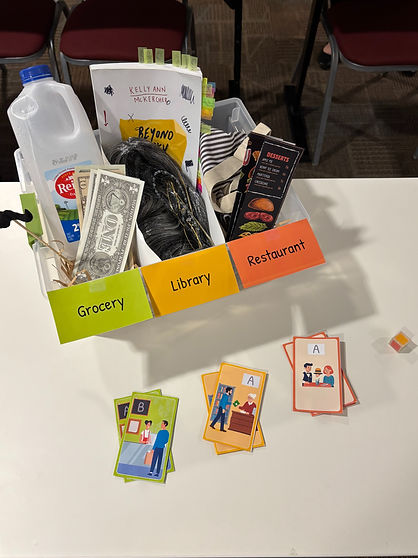

Testing at Aspirations' Nisonger
Results
Several youth were uncomfortable with the props, especially wigs, and the short time frame made it difficult for them to adjust. All participants relied on reading the written sentences instead of improvising, suggesting that the combined prompts and prop instructions on each card were overwhelming. A simpler card design may be more effective for autistic youth. One participant also noted difficulty making decisions, choosing both activities instead of selecting one.
How Round 1 shaped Round 2
.jpg)
Prototype Cycle 2
This activity builds on the previous session involving objects, but offers participants greater freedom of choice. The handbook is divided into two parts:a set of characters and their locations, and a set of conversation topics.
Participants shape the conversation according to their own preferences. The direction, style, and content of the dialogue are determined by the participants, as long as the discussion relates to the selected topic.To begin, participants flip through the first section to select a character and setting, then use the second section to choose a conversation topic. One partner takes on the role of the chosen character.After one round of the activity is completed, the turn shifts to the other partner, who selects the next character, setting, and topic.


Testing at Aspirations' Nisonger
Results
Participants responded naturally to the prompts.
They described trips, foods, preferences, and asked follow-up questions.
They were able to stay in character, showing that the activity supports back-and-forth conversation without scripts or pressure.
Based on all comments, the activity was simple, easy to understand, and less overwhelming.
Youth expressed enjoyment and even enthusiasm (for example: “People keep saying that I should be a voice actor someday.”).
The format made it easier to “get into character.”
Comfort levels varied, which is consistent with ASD youth performance preferences, but no one said the activity was confusing or difficult.
Unlike the previous activity with props, there were no complaints about sensory discomfort, too much structure, or confusion.

Generated by Chat GPT